The Galata Tower — called Christea Turris (the Tower of Christ in Latin) by the Genoese — is a medieval stone tower in the Galata/Karaköy quarter of Istanbul, Turkey, just to the north of the Golden Horn. One of the city's most striking landmarks, it is a high, cone-capped cylinder that dominates the skyline and offers a panoramic vista of Old Istanbul or Constantinople and its environs.
Se afișează postările cu eticheta TURKEY. Afișați toate postările
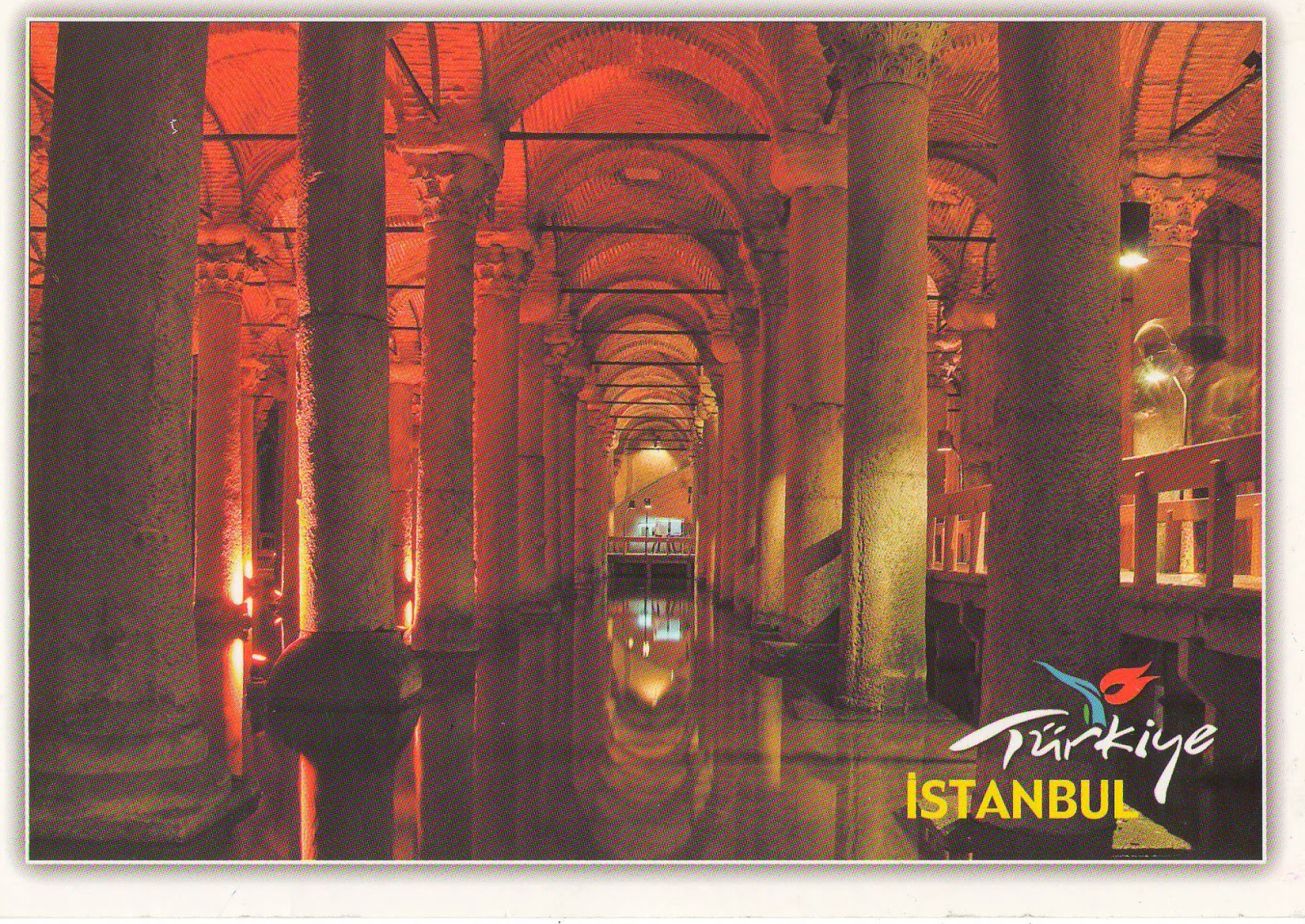
The Basilica Cistern, Istanbul
The Basilica Cistern is the largest of several hundred ancient cisterns that lie beneath the city of Istanbul. The cistern, located 150 m southwest of the Hagia Sophia, was built in the 6th century during the reign of Byzantine Emperor Justinian. This cathedral-size cistern is an underground chamber approximately 9,800 square metres in area - capable of holding 80,000 cubic metres of water. The ceiling is supported by a forest of 336 marble columns, each 9 metres high, arranged in 12 rows of 28 columns each spaced 4.9 metres apart.
Istanbul
Istanbul is the largest city in Turkey, constituting the country's economic, cultural, and historical heart. With a population of 13.9 million, the city forms one of the largest urban agglomerations in Europe and is among the largest cities in the world by population within city limits. Istanbul is a transcontinental city, straddling the Bosphorus—one of the world's busiest waterways—in northwestern Turkey, between the Sea of Marmara and the Black Sea. Its commercial and historical center lies in Europe, while a third of its population lives in Asia.
Hagia Sophia, Istanbul
Is a former Orthodox patriarchal basilica, later a mosque, and now a museum in Istanbul. From the date of its dedication in 360 until 1453, it served as an Eastern Orthodox cathedral except between 1204 and 1261, when it was converted to a Roman Catholic cathedral under the Latin Empire. The building was a mosque from 29 May 1453 until 1931, when it was secularized. Famous in particular for its massive dome, it is considered the epitome of Byzantine architecture and is said to have "changed the history of architecture". It remained the world's largest cathedral for nearly a thousand years thereafter, until Seville Cathedral was completed in 1520.
Istanbul
Istanbul is the largest city in Turkey, constituting the country's economic, cultural, and historical heart. With a population of 13.9 million, the city forms one of the largest urban agglomerations in Europe and is among the largest cities in the world by population within city limits. Istanbul is a transcontinental city, straddling the Bosphorus—one of the world's busiest waterways—in northwestern Turkey, between the Sea of Marmara and the Black Sea. Its commercial and historical center lies in Europe, while a third of its population lives in Asia.
Istanbul
Istanbul is the largest city in Turkey, constituting the country's economic, cultural, and historical heart. With a population of 13.9 million, the city forms one of the largest urban agglomerations in Europe and is among the largest cities in the world by population within city limits. Istanbul is a transcontinental city, straddling the Bosphorus—one of the world's busiest waterways—in northwestern Turkey, between the Sea of Marmara and the Black Sea. Its commercial and historical center lies in Europe, while a third of its population lives in Asia.
Hagia Sophia, Istanbul
Is a former Orthodox patriarchal basilica, later a mosque, and now a museum in Istanbul. From the date of its dedication in 360 until 1453, it served as an Eastern Orthodox cathedral except between 1204 and 1261, when it was converted to a Roman Catholic cathedral under the Latin Empire. The building was a mosque from 29 May 1453 until 1931, when it was secularized. Famous in particular for its massive dome, it is considered the epitome of Byzantine architecture and is said to have "changed the history of architecture". It remained the world's largest cathedral for nearly a thousand years thereafter, until Seville Cathedral was completed in 1520.
Sultan Ahmed Mosque, Istanbul
The mosque is popularly known as the Blue Mosque for the blue tiles adorning the walls of its interior. It was built from 1609 to 1616, during the rule of Ahmed I. Like many other mosques, it also contains a tomb of the founder, a madrasah and a hospice. While still used as a mosque, the Sultan Ahmed Mosque has also become a popular tourist attraction. At its lower levels and at every pier, the interior of the mosque is lined with more than 20,000 handmade ceramic tiles, made at Iznik in more than fifty different tulip designs. The most important element in the interior of the mosque is the mihrab, which is made of finely carved and sculptured marble, with a stalactite niche and a double inscriptive panel above it.
Hagia Sophia, Istanbul
Is a former Orthodox patriarchal basilica, later a mosque, and now a museum in Istanbul. From the date of its dedication in 360 until 1453, it served as an Eastern Orthodox cathedral except between 1204 and 1261, when it was converted to a Roman Catholic cathedral under the Latin Empire. The building was a mosque from 29 May 1453 until 1931, when it was secularized. Famous in particular for its massive dome, it is considered the epitome of Byzantine architecture and is said to have "changed the history of architecture". It remained the world's largest cathedral for nearly a thousand years thereafter, until Seville Cathedral was completed in 1520.
Zile, Tokat
Also known as Zela, is a city and a district of Tokat Province. The city has a long history, including being the site of the Battle of Zela, which prompted the phrase "Veni, vidi, vici."
Bodrum Castle
Was built by the Knights Hospitaller starting in 1402 as the Castle of St. Peter or Petronium. The construction of the castle began under the German knight-architect Heinrich Schlegelholt. Construction workers were guaranteed a reservation in Heaven by a papal decree of 1409. For over a century, St. Peter's Castle remained the second most important castle of the Order. It served as a refuge for all Christians in Asia Minor.
Marmaris
Marmaris is a port city and a tourist resort on the Mediterranean coast. Although it is not certain when Marmaris was founded, in the 6th century BC the site was known as Physkos. According to the historian Herodotus, there had been a castle on the site since 3000BC.
Sarayburnu Maiden's Tower and Prince's Island, Istanbul
It was first built by the ancient Athenian general Alcibiades in 408 BC to control the movement of the Persians. It was later enlarged and rebuilt as a fortress by the Byzantine emperor Alexius Comnenus in 1110 AD. The Maiden's Tower was used as a lighthouse for centuries and now it has been transformed into a café and restaurant with an excellent view over the former Roman, Byzantine and Ottoman capital.
Sultan Ahmed Mosque (the Blue Mosque), Istanbul
The Sultan Ahmed Mosque is an historical mosque in Istanbul. The mosque is popularly known as the Blue Mosque for the blue tiles adorning the walls of its interior.
It was built from 1609 to 1616, during the rule of Ahmed I. Like many other mosques, it also comprises a tomb of the founder, a madrasah and a hospice.
Abonați-vă la:
Postări (Atom)